Breast Milk Bank | Breast Milk Donation
We provide information regarding the breast milk bank, the criteria for accepting breast milk donations, and the procedures for using breast milk. For inquiries regarding breast milk donation, please contact MDA about the Breast Milk Bank Project. Breast milk is the best food for every newborn, especially for premature babies. When the newborn is not fed with its mother's milk, feeding with pumped and pasteurized breast milk from a donor, provided by a regulated breast milk bank, is preferable to feeding with infant formula. Feeding with controlled breast milk from a milk bank can prevent morbidity and mortality, shorten hospitalization days, and save on newborn care expenses. Donated breast milk has been proven to be particularly effective in preventing necrotizing enterocolitis (NEC). MDA's National Breast Milk Bank, in a joint project with the Ministry of Health, officially opened in August 2020, but its continuous operation has not yet been regulated as of early 2021.
View the procedures for using milk from a breast milk bank
Procedure for using milk from a breast milk bank
For inquiries regarding breast milk donation
Indications for giving breast milk
Magen David Adom's National Breast Milk Bank
Contact information:
To the MDA Milk Bank website >>
7 HaMag Street Jerusalem 07-32630201 Fax: 07-32630200 Phone: milkbank@mda.org.il
Who can donate breast milk?
Milk donors are supposed to meet special conditions that ensure their eligibility to serve as milk donors and the safety of the expressed milk. The minimum eligibility conditions include a column on the condition for blood donation, and to these are added conditions that ensure the long-term eligibility of the donor mother and the safety of the expressed milk by the mother. Donated milk travels a long way until it reaches the baby in need, so it is important that it is expressed and stored under very strict conditions. These rules do not bind you when you express for your child. Equally, you may discover that there are life circumstances that prevent you from being a milk donor. Of course, this does not indicate that you cannot breastfeed your child or that "your milk is not good", in the same way that healthy and vital people cannot sometimes donate blood, so are milk donors. In any case of doubt about your eligibility as a milk donor, you are welcome to contact us at: milkbank@mda org.il The full criteria for donating breast milk from the MDA website are detailed here
Recommended target population for receiving donated breast milk
(From a circular from the Head of Public Health Services)
First priority
- Premature babies weighing up to 1500 grams or less than 32 weeks gestational age
- Infants suffering from malabsorption syndromes and/or intolerance to formula
- Infants suffering from immune system deficiency syndromes
- Babies with congenital defects in the digestive system
- Additional medical allowances for breast milk according to the decision of the bank's medical director
Second priority
- Premature babies not listed above
- Breastfeeding failure
- A baby given up for adoption or surrogate birth
- Maternal illness that prevents breastfeeding
Click here to viewBreast milk bank circular – Head of Public Health Services
Extension of maternity leave for a premature mother
A mother whose baby is hospitalized, or needs to be hospitalized again, for a period of at least 15 days during maternity leave is entitled to extend her maternity leave by a number of days equal to the number of days of hospitalization and up to a maximum period of 20 weeks.
- During the extension period, you can receive Maternity benefits Up to the maximum number of days listed below:
- 20 additional weeks, if the mother is entitled to payment Maternity benefits For 15 weeks.
- An additional 12 weeks, if the mother is entitled to maternity benefits for 8 weeks.
- In this case, it is also possible to split the maternity leave (temporarily suspend it for the duration of the hospitalization, and resume it upon its completion), so that the hospitalization period will not be calculated as a period in which the entitlement to maternity leave was used. For more information, see Splitting maternity leave.
Who is eligible?
- A woman whose baby she gave birth to needs to be hospitalized, or re-hospitalized, for at least 15 days (even if they are not consecutive) during Maternity leave its.
- Men are allowed to share maternity leave with their partners starting from the seventh week after birth, provided that the partner is entitled to maternity leave, but has chosen to shorten the maternity leave and return to work.
The process of exercising the right
Delivering a message to the employer
- The employee must provide written notice to the employer at least 4 days before the date she was supposed to return to work. If, under the circumstances, she is unable to provide notice on that date, she must provide it at the earliest possible date.
- The notification must be accompanied by confirmation from the hospital or a doctor on its behalf regarding the premature baby's hospitalization period.
Request for extension of maternity benefits
- The mother must fill out Claim form for extension or splitting of maternity benefits.
- The form can be submitted within one year from the first date of eligibility forMaternity benefits, and only after the claim for maternity benefits was filed.
- The claim form must be accompanied by a certificate from the hospital, which will record the details of the mother and baby and the time of hospitalization.
- The form and approval are submitted toThe branch of the National Insurance Institute nearest to your place of residenceYou can also submit the claim by mail, fax, or in the branch's service box.
- There is also the option to scan or take a photo of the form and confirmation and submit them online using The National Insurance Institute website.
Important to know
- if Both the baby and the mother were hospitalized. While she was eligible for maternity leave, and their hospitalization periods were shorter than 15 days and did not overlap, both of their hospitalization periods can be combined, so that eligibility to extend the maternity leave will be possible (if both periods total 15 days).
The information from the site is all right.
We continue to work for you!
"Premature birth allowance from National Insurance"
The main rules for determining eligibility for a National Insurance benefit for premature babies
Based on the Child Protection Circular updated on 12/21/20 and the National Insurance website
A study conducted by the National Insurance Institute shows that the care of premature babies in the first period after their birth involves a great burden on the parents, as many premature babies suffer from problems that require supervision and/or routine treatments and monitoring on various issues (such as: eating difficulties, problems resulting from various infections, problems resulting from the immaturity of systems, for example, respiratory arrests, etc.).
Therefore, it was decided on a number of grounds on which eligibility for receiving a temporary disabled child allowance (for 6 months) can be determined:
Partial supervision (at a rate of 50%, allowance amount - 1,880 NIS as of January 2025):
Premature infants born up to 6+32 weeks or with a birth weight of less than 1750 grams – temporary eligibility for 6 months from the age of 3 chronological months to the age of 9 chronological months. Eligibility will be determined without summoning the child to the committee.
Premature infants who were in the preterm unit for a period of 30-44 days – temporary eligibility for 6 months, from 91 chronological days to 9 chronological months. Eligibility will be determined without summoning the child to the committee.
Premature infants who have been in a premature infant care facility for a period of 45 days or more – temporary eligibility for 9 months, from the chronological age of 91 days to the chronological age of one year. Eligibility will be determined without summoning the child to the committee.
Special care (at a rate of 100%, the amount of the allowance is 3,694 NIS as of January 2025)
In cases of premature babies who accumulate 3 sections - "monitoring in a specialist clinic", hospitalization for 45/30 days, and "partial supervision", or in the presence of a specific section such as oxygen, gastrostomy, ileostomy, anticonvulsant medications, etc.
"Severe medical treatment" (at a rate of 188%, the amount of the allowance - 6,947 as of January - 2025)
In the case of premature babies who have been in a premature baby home for at least 3 consecutive months, the benefit will be provided from the day of birth until the end of the calendar month in which they were discharged home.
"As of January 2022, there are five levels of eligibility for a disabled child allowance"
Three as detailed above, and two more:
- 112% – The amount of the allowance is 4,352 NIS as of January 2025
- 235% – The amount of the allowance is 8,828 NIS as of January 2025
A child who has more than one medical problem If he is entitled to a pension, he will be paid the pension according to the medical problem that entitles him to the highest amount.
For current information from National Insurance Click
Summary of possible grounds for eligibility for the deadline
It should be noted that:
Eligibility for the premature birth benefit will be determined without the need for a summons and/or examination of the child by the committee. Eligibility for this benefit will be determined based on documents, up to the chronological age of 9 months.
Were you summoned to the committee anyway? Apparently the doctor who handled the claim and the documents you submitted thinks that there are Reasons Other than the deadlines, they should be examined by the committee.
There is nothing to fear from the committee.Ultimately, additional reasons can earn you higher percentages.
A family with two or more "disabled" children is entitled to an increased benefit of 50% for each child, in accordance with the benefit determined for them. For example, in a family with two disabled children, for which one child is determined to be eligible at a rate of 100% and for the second at a rate of 50%, an increased benefit of 50% will be paid for each child. That is, for the first child the increased benefit rate will be 150%, and for the second child 75%.
The allowance will be paid up to one year retroactively from the date the claim is filed. The circular applies and is eligible for payment: 1.1.2020. That is, in cases of retroactive claims, the circular is relevant to any premature baby who meets the criteria of week or birth weight as specified in section 1 above, and was less than 9 months old on 1.1.2020. If he was more than 3 months old on 1.1.2020, he will only receive it for the period from this date until the date he turns 9 months old.
A future claim can be filed before the child turns 3 months old. However, in any case, entitlement and benefits will only be granted from the age of 3 months.
At the end of the temporary period, up-to-date medical documents can be sent regarding the child's condition and the treatments he is receiving, for the purpose of examining developmental delay and/or other grounds that qualify for a different allowance.
If during the temporary period there is a worsening or new medical condition, you must fill out Re-examination form and send along with medical documents accordingly.
How to submit the application
A form must be downloaded from the National Insurance website.Disabled child benefit“
A letter of discharge from confinement and any other relevant document must be attached to the form.
In our experience, it is worth attaching any document that may be relevant because there may be additional grounds that qualify for a higher allowance (in which case, you will likely be summoned to the committee).
On the form, the word “Pauses” must be written in section 4, last line (medical complaints).
The form can be filled out OnlineAnother option is to send via National Insurance website, by fax, by mail or by placing them in the service boxes at the branches.
For detailed inquiries and additional questions regarding claim handling and rights and service issues:
National Social Security hotline *6050 or 04-8812345 (Sunday-Thursday between 8:00-17:00)
More information about benefits related to the pension here.
Sick days For the purpose of personal assistance from a parent for premature infants recognized by National Insurance under the "Disabled Child" benefit - Premature Infants Circular
The premature baby returns to the community
Monitoring and care of complex newborns and premature infants upon discharge from hospitalization to the community
Link to the Premature Baby in the Community Circular 2016 – To read in an accessible format, click here
In November 2014, the Lahav Association placed the issue of caring for premature infants in the community on the table of the Knesset Premature Infant Day committees. We raised and emphasized the importance of early developmental intervention upon the premature infant's release from the preemie ward and the need for parents and families for a professional treatment continuum that will address the feeling of vacuum that is created after the premature infant is released from the preemie ward.
Following the committees that day, we were asked to conduct a survey on the subject, which was conducted in December 2014, among a group of parents of premature babies on social media. The survey revealed difficulties in caring for the premature baby and his family, and in recognizing the special medical and developmental needs of the premature baby in the milk drops, among primary care pediatricians and also in queues at child development centers.
The survey revealed a worrying picture of the situation, which led the Ministry of Health and Dr. Tzangan, who heads the Neonatologists' Association, to formulate a circular that would regulate follow-up and treatment after discharge from the hospital.
The members of the Lahav Association's Executive Committee were part of the formulation of the circular from the perspective of the families' needs. Yael Shmaya (Chairman of the Association's Executive Committee) - a premature dietician and Shiri Kertin (member of the Executive Committee) - a neuro-developmental physiotherapist - also served as professional consultants in their fields.
After two years of work on the circular, on Premature Baby Day 2016, the circular went into effect and brought good news to the parents of premature babies.
First, the circular defines for the first time all the tests, training, and treatments that premature babies need after being discharged from the hospital.
Second, the circular included the entire population of premature infants (complex and normal) as an at-risk population requiring special monitoring early in their lives. Another innovation is the definition of the complex newborn – a premature infant can be born after week 32 and due to complications in prematurity be included under the definition of complex prematurity and receive the associated rights.
The circular emphasized the issue of early intervention by increasing medical, developmental, and nutritional sessions in the first months of life.
In summary – the innovation in the circular:
- Therapeutic and medical continuity from hospitalization in the neonatal unit to the transition home in the community (note the responsibility of your pediatrician as the center of care for the premature baby). It is recommended that parents register with the pediatrician and a milk dropper before the discharge date and provide relevant material that will enable continuity of care.
- First meeting with the treatment center pediatrician – within two weeks of discharge.
- All premature babies will receive a physiotherapy assessment within 3 months (complex premature babies within a month)
- A complex premature infant will receive a nutritional assessment within a month of discharge from the neonatal intensive care unit. It is also clearly defined which premature infants also need a nutritional assessment regardless of week and birth weight (within 3 months).
The Lahav Association welcomes the publication of this important circular and invites parents of premature babies to ask questions via the hotline and Facebook group and demand your rights and the rights of your premature babies. We are here to help make the circular a reality on the ground.
RSV
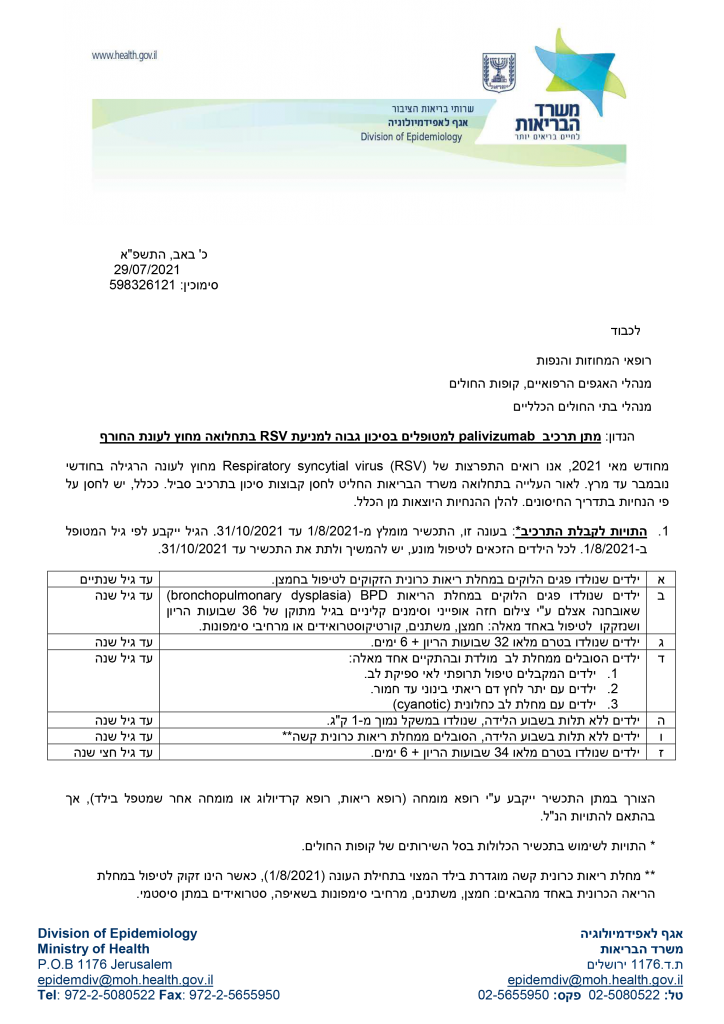
Table of eligible persons (**Determining date for calculating chronological age - 1/11)

What is the RSV virus?
RSV – Respiratory Syncytial Virus – RSV is the leading cause of lower respiratory tract infections in children and premature infants. The virus causes upper respiratory tract infections (URTI) in adults and children, but in premature infants it often develops into a more severe lower respiratory tract infection (LRTI) and can result in prolonged hospitalization, intensive care unit stay, and even death.
RSV occurs seasonally from fall to spring. The infection is transmitted through sneezing, coughing, and contact of the baby with surfaces contaminated with the virus (surfaces/objects that have been in contact with a sick baby or child).
There is no adequate treatment for this virus, so preventive treatment is extremely important as the right solution for preventing RSV and the complications of the disease.
RSV symptoms usually first appear as a mild flu: low-grade fever, runny nose, and ear infections. After 3-5 days, symptoms may worsen if the virus has spread to the lower respiratory tract and include coughing, difficulty breathing, rapid breathing, and wheezing due to airway narrowing.
Dr. Bader, director of the neonatal and preterm intensive care departments at Bnei Zion Hospital in Haifa, affiliated with the Technion's Faculty of Medicine, explains:
"The RSV virus is most common in the winter months and attacks the entire population of children up to the age of two. If the virus attacks a baby in the first two months of life, the disease is more severe and develops into pneumonia (bronchiolitis), which in severe cases may cause shortness of breath, respiratory arrest and the need to hospitalize the baby."
In severe cases of the disease, there is even a need to hospitalize the baby in an intensive care unit. Recent studies in the field have shown that newborns in the early stages of life or premature babies who have had a severe illness due to RSV develop bronchial asthma as they grow up.”
Why is the RSV virus dangerous for premature babies?
Immediate risk
- The virus is highly contagious and can cause severe illness in young infants.
- About half of all babies are infected with the virus by the age of one year, and 85%-100% are infected by the age of two.
- A premature baby infected with the virus is twice as likely to be hospitalized as a full-term baby.
- Premature babies born relatively late in pregnancy are also almost twice as likely to be hospitalized after contracting the virus as children born at term.
- RSV is the number one cause of hospitalization in infants up to one year of age and the leading cause of viral pneumonia in children up to 5 years of age.
- The RSV virus causes approximately 401% of all hospitalizations for lung infections in children and may result in prolonged hospitalization and even intensive care stays.
- Tens of thousands of babies worldwide die from this virus.
Long-term risk
RSV may cause long-term lower respiratory tract complications. New research has found that in addition to the immediate danger posed by RSV, it may cause lower respiratory tract complications throughout childhood. Epidemiological data show an association between hospitalization at a young age due to RSV infection and chronic respiratory complications such as recurrent wheezing and asthma that may persist into adolescence.
Several large studies have found that the development of lower respiratory tract infections due to RSV infection in the first two years of life is a risk factor for the future development of wheezing and recurrent wheezing up to age 11.
RSV prophylaxis
There is a preventive treatment called Abbosynagis that is given monthly during the winter months (November-March) and is included in the health basket and is provided free of charge to those eligible:
- Premature infants, those with chronic lung disease and requiring oxygen therapy – up to two years of age.
- Premature infants, who have lung disease diagnosed by a typical chest x-ray and clinical signs (BPD – bronchopulmonary dysplasia) at a corrected age of 36 weeks gestation and who require treatment with one of the following: oxygen, diuretics, corticosteroids (steroids) or bronchodilators – up to one year of age.
- Premature babies born up to week 32+6, if they are not yet one year old on November 1st of that winter season (a baby born after November 1st will also be vaccinated the following season).
- Premature babies born up to week 34+6, if they are not yet six months old on November 1st of the same season.
- Babies, regardless of the week of birth, born weighing less than 1 kg - up to one year of age.
- Infants, regardless of the week of birth, who suffer from severe chronic lung disease – up to one year of age.
- Infants suffering from congenital heart disease and with one of the following conditions, up to one year of age:
- – Infants receiving drug treatment for heart failure
- – Infants with moderate to severe pulmonary hypertension
- – Infants with cyanotic heart disease
The first vaccination is given in the neonatal unit near discharge (in season only). The baby will receive the following vaccinations in the community and will be invited to receive them by the health fund.
All children eligible for preventive treatment should continue to receive the product until the end of the virus's peak activity season.
It is important that parents are aware of their eligibility and insist on their right to receive the vaccine.
The importance of administering 5 doses of vaccine during RSV
All studies, including the registry study, examined the treatment efficacy of 5 monthly treatments throughout the entire RSV season.
Hand and colleagues showed in a study published in 2008 in Pediatr Infect Dis that among premature infants who missed one in five vaccines, an increased rate of RSV-only hospitalizations and unscheduled doctor visits was observed.
Administering monthly treatments continuously throughout the season allows serum levels of over 40 micrograms per milliliter to be reached, while inconsistent monthly administration during the season does not allow this desired level to be reached, resulting in an increase in hospitalizations.
Summary of a study indicating a 50% reduction in recurrent wheezing among premature infants who received Abbosynagis compared to the control group:
Research objective:
Children who have experienced lower respiratory tract RSV infection early in life are at increased risk of recurrent wheezing. Palivizumab (a monoclonal antibody) has shown 80% efficacy in preventing RSV-related hospitalizations in premature infants without chronic lung disease.
It is hypothesized that preventing RSV infection in premature infants may reduce recurrent wheezing in premature infants.
Methods:
191 premature infants who received RSV prophylaxis were compared with 230 premature infants who did not receive prophylaxis. Prospective follow-up was performed for 2 years, during which rates of recurrent wheezing were assessed, both by parental and physician reports.
Results:
Among premature infants who received the preventive treatment, a 50% reduction in recurrent wheezing rates, including recurrent wheezing diagnosed by a physician (26% vs. 16% and 13% vs. 8%), was observed.
conclusion:
Research suggests that preventing lower respiratory tract RSV infection through prophylactic treatment can reduce recurrent wheezing in premature infants.
Clinical experience in Israel
In Israel, as in the Western world, respiratory-related hospitalizations are the main cause of hospitalization among newborns up to one year of age. In Israel, the number of hospitalizations caused by RSV is estimated at approximately 4,100 (Prof. Somekh, 2008).
It can also be seen from the data from the Infectious Diseases Unit in Soroka that lower respiratory tract infections are the main reason for visits to the emergency room, both among Jews and Bedouins.
The effectiveness of treatment in Israel was studied at Shaare Zedek Hospital, which has a birth rate of approximately 12,000 births per year, and Soroka Medical Center, which leads in the number of births in Israel (approximately 16,000 births per year).
At Shaare Zedek Medical Center, a review was conducted of data on premature infants up to 29 weeks of gestation who received the vaccine during 5 consecutive years, 2002-2007 (5 consecutive winters), and it was found that out of 159 premature infants, none was hospitalized with a diagnosis of RSV over 5 consecutive seasons. It can be seen that the average length of hospitalization was 4.96 days among the unvaccinated population.
At Soroka Medical Center, headed by Prof. Asher Tal, Director of the Pediatrics Department B, the effectiveness of the vaccine in reducing the average length of hospitalization for those hospitalized with RSV was studied in 94 premature infants up to week 29 compared to a control group (premature infants who were not vaccinated at all or received less than 3 vaccines), between the years 2001-2007.
The average length of hospital stay decreased by 46%. From an average of 9.4 days among the control group to 5.1 among the children who received Abbosynagis.
Lahav Association's activities to expand the basket of medicines
Year 2001
- Premature infants and infants born prematurely up to two years of age who suffer from chronic lung diseases and require oxygen therapy
- Premature infants and infants born prematurely up to one year of age with bronchial asthma (BPD) diagnosed by chest x-ray at a corrected age of 36 weeks gestation and requiring treatment with one of the following: oxygen, diuretics, corticosteroids, or bronchodilators
- Premature babies and babies who were born prematurely and are not yet one year old, if they were born before they reached 28 weeks of gestation
Year 2009
- Premature babies born between the 29th week of pregnancy and the 31st week + six days – up to a year after birth
Year 2011
- Premature babies and those who were born prematurely and who are not yet one year old, if they were born before they reached 32 weeks of pregnancy + 6 days. (Extension of the indication included in the basket)
Year 2014
- Expanding the inclusion framework in the basket for premature babies and those who were born prematurely and who are not yet six months old, if they were born before completing 34 weeks of pregnancy + 6 days.
Year 2021-2022
- Due to the coronavirus pandemic, the overall winter illness broke out late, and starting on May 21, we witnessed a worrying outbreak of RSV infection. The RSV vaccine is usually given between fall and spring, and premature babies are then vaccinated against it. The vaccine is included in the drug basket, but due to the unusual outbreak, we acted to advance the vaccination.
- An advisory committee to the Ministry of Health met in June and recommended bringing forward the vaccination season, and we areLahav Association We have worked hard to implement this recommendation, including: Address to the Minister of Health, Mr. Nitzan Horowitz.
- The exceptional morbidity season lasted from August 1, 2021 to October 31, 2021, after which the vaccine was administered according to the usual guidelines.
- Towards the end of the "regular" season, as early as February 22, we recognized that there was no decline in RSV cases and that it would not be enough to vaccinate premature infants until the end of March alone. In light of data on continued high morbidity, We contacted the Ministry of Health with concern. And to the Neonatologists' Association to examine the continuation of vaccination of premature babies, as long as the level of morbidity is so high.
- On 3/27/22, following letters from the Lahav Association, the Ministry of Health's Vaccination Committee unanimously recommended expanding the continuation of RSV vaccination for premature infants due to high virus activity in Israel, to at least April and May.
- On 4/4/22, the Ministry of Health Issued a directive to vaccinate all eligible premature babies. This means that all premature infants who are discharged from the hospital should receive a dose of the vaccine in the hospital. All premature infants who received a dose of the vaccine in March will receive another dose in April.
Click here to go to the form Contact the Ha-Hav Association regarding the RSV vaccine